
How is the content marketing sector evolving? If you don’t know the answer to this question, you won’t know how to modify your own content plan for growth. Although you might have a gut feeling, concrete information is always preferable because it will enable you to create the ideal strategy and formulate your budget.
Here are 60+ content marketing statistics that will help you with your efforts.
1. General Content Marketing Stats and Facts
Let us start with some general stats, facts, and trends, and as we progress down the list, we will look in detail at some more specific topics.
1. 90% of business owners with a content marketing plan say they will continue investing the same amount of funds in quality copy in 2022.
2. 66% of marketers say their 2022 content marketing budget has significantly increased compared to the one they had in 2021.
3. More than 60% of marketers use their sales levels to calculate the success of their content marketing strategy.
4. The top 3 organic content distribution channels used by B2B marketers:
- Social media,
- Email,
- Their own blog/website
5. 73% of businesses that allocate 10% to 70% of their marketing budget to content marketing report high success levels.
6. The number of content creators has risen by 52% between 2021 and 2022.
7. Alongside content marketing, content strategy is the subject that gets the most attention on Twitter.
8. Getting quality leads with content is the biggest marketing difficulty.
9. More than 90% of marketing professionals think the COVID-19 epidemic would negatively affect their content marketing strategies in the long run.
10. According to 52% of B2B content marketers, their success over the past 24 months was a result of “adapting to changes brought about by the pandemic.”
11. The most frequent Google searches for content marketing in 2021 were “content marketing examples” and “content marketing strategy.”
12. Around 50% of marketing managers outsource their content creation activities.
13. Finding content creators with sufficient subject matter knowledge is the biggest difficulty, according to 65% of marketers.
14. 59% of businesses say they employ between 1 and 5 content creators, while 32% of companies admit they didn’t have even one.
15. The primary objective of content marketing for 2022 is raising brand awareness.
2. Content Marketing Stats and Facts That Can Help You Better Your Strategy
Creating a working content management strategy cannot be done overnight. Finding what works best for your brand and business niche takes a lot of trial and error. A good starting point is to observe your competitors and learn from their successes and mistakes. With that in mind, here are a couple of stats and facts that will make you look deeper into your strategy.
16. The top 3 objectives marketers are able to accomplish with effective content marketing are:
- Brand awareness,
- Credibility and trust-building,
- Audience education.
17. The biggest challenges marketers face with content marketing are:
- creating content that generates leads,
- finding ideas for a new copy,
- creating engaging content.
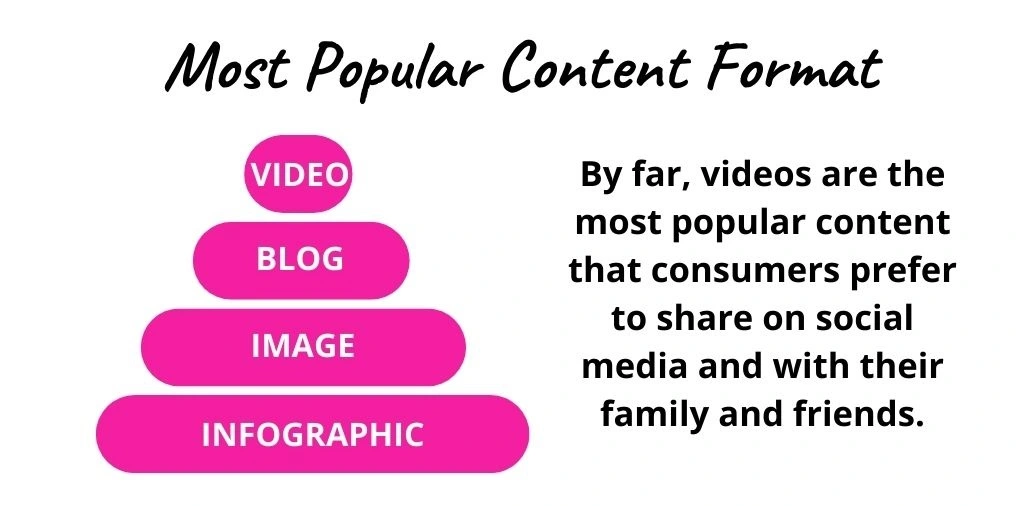
18. The most popular format used by marketers in their content strategy in 2021 is video, followed by blogs, images, and infographics.
19. Targeting strategic keywords is the most popular SEO tactic that over 71% of marketers use.
20. Over half of the companies investing in content marketing publish new copy daily.
21. Almost 90% of marketing professionals prioritize the needs of their audience over their business sales message.
22. The most outsourced content marketing activity, according to B2B marketers, is content creation.
23. 96% of B2B content marketers use Linkedin
24. Less than 30% of marketers admit not using any paid content distribution channels.
25. Almost 80% of marketing professionals do keyword research while creating content.
26. 71% of content marketers begin their research with a generic search instead of a brand-related one.
27. The top 3 most frequently used SEO metrics are:
- keyword ranking,
- organic traffic,
- time spent on page
28. According to experts, “the best day to publish new content” is a myth, as the social shares are distributed evenly among posts published on different days of the week.
29. The top 3 most widely used technologies that help marketers in creating content are:
- analytics tools,
- social media publishing/analytics,
- email marketing software.
30. Almost 65% of content marketers rely on Google Analytics for measuring their content performance.
31. The top content management system used by marketers is WordPress.
32. Roughly 80% of businesses that record their content marketing strategy are successful with it.
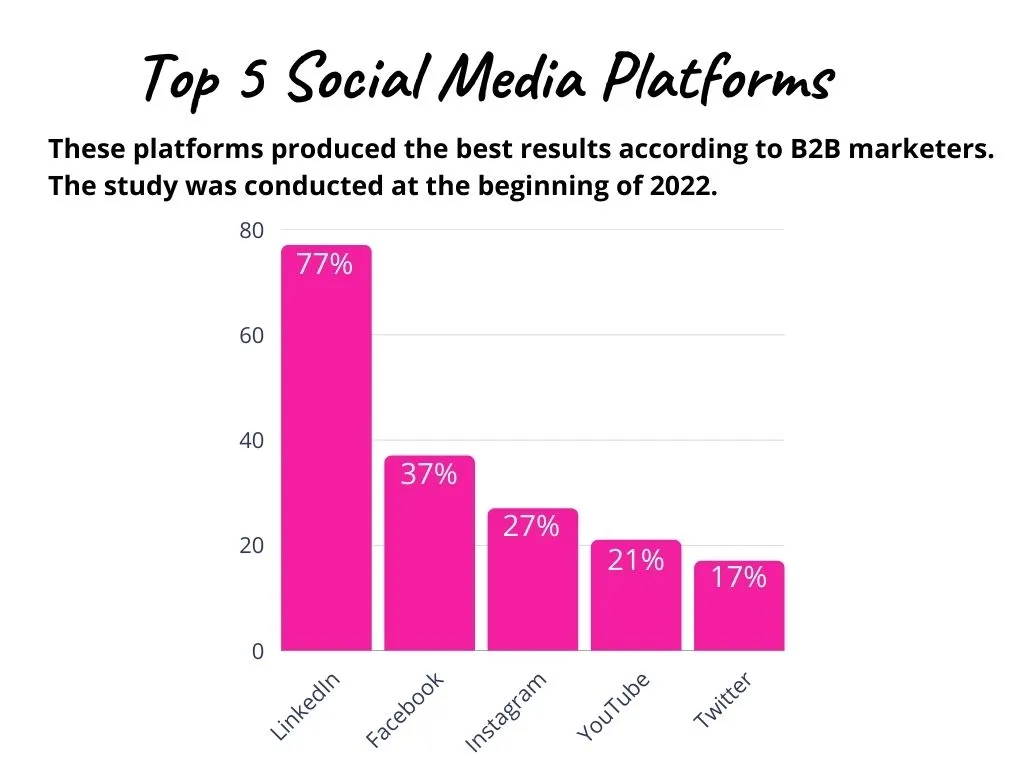
33. The 5 best organic social media platforms that produced the top results at the beginning of 2022 were:
- LinkedIn,
- Facebook,
- Instagram,
- YouTube,
- Twitter.
Source: Content Marketing Benchmarks, Budgets, and Trends: Insights for 2022 report
34. The majority of social media content is visual (85%).
35. Content marketing costs 62% less and produces more than three times as many leads as outbound marketing.
36. 42% of businesses claim to have designated personnel for their content marketing strategies.
37. One of marketers’ biggest concerns is the constant changes in social media and search engine algorithms.
38. Over 80% of marketers plan to increase original content use.
39. Almost 70% of professionals who have used email marketing and PR tactics claim that content marketing is more effective than both.
40. According to content marketing ROI stats, the majority of content marketing campaigns start with a negative ROI (so don’t despair if you don’t succeed on your first try).
3. Facts and Stats about Consumers
Trust has become one of the main issues for modern buyers. You can use content marketing to build a better relationship with your target audience and provide it with the information and support it seeks. A well-written copy can both attract new clients and cater to the needs of your existing ones. The following stats and facts will help you determine what the average consumer likes and dislikes.
41. Almost 80% of consumers admit that seeing a video persuaded them to purchase or download a piece of software or an app.
42. 73% of people say they skim blog content, compared to 27% who read it fully.
43. Around 32% of consumers admit that sometimes they feel overwhelmed by the large amount of information available.
44. Roughly 45% of people admit to reading 3 to 5 pieces of content before approaching a business.
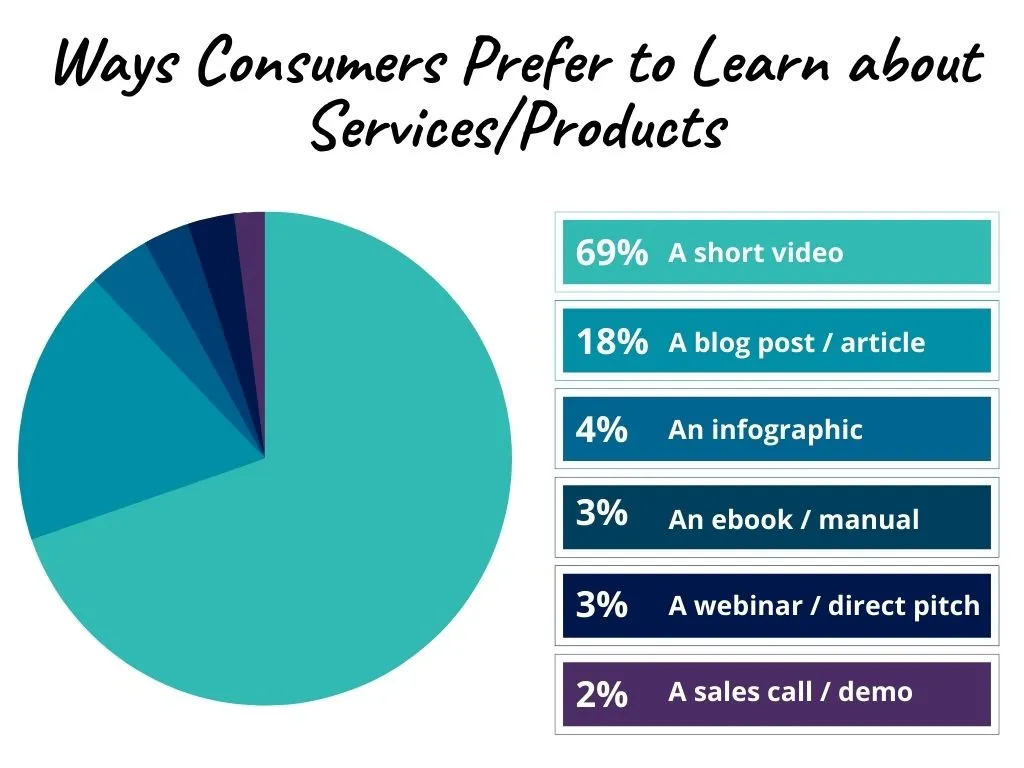
45. The most ways people prefer to learn about a product/service are:
- A short video,
- A blog post or article,
- An infographic,
- An ebook or manual,
- A webinar or a direct pitch,
- A sales call or a demo.
46. Mobile devices account for about two-thirds of all internet searches worldwide.
47. 53% of consumers claim to always conduct research before making a purchase to guarantee they are choosing the best option.
48. The top 3 most popular written content forms are:
- How-to articles(77%),
- news and trends (49%),
- guides, and ebooks (47%).
49. People are twice as likely to share videos with their acquaintances Compared to other types of information, such as blog entries, product pages, and social network postings.
50. 78% of short articles (less than 500 words) haven’t been shared at all.
51. 3000+ word articles receive 138% higher traffic than those with less than 500 words.
52. Engagement decreases for articles that take more than seven minutes to read.
53. 70% of people who saw a brand on YouTube made a purchase from it.
54. People who follow instructions with text and images do 323% better than those who follow guides without illustrations.
55. Visual content marketing statistics show an 800% rise in the demand for infographics.
56. Infographic content is 30x more likely to be read by audiences than text.
57. 41% of consumers claim to place greater importance on the trustworthiness of the content’s source.
58. Roughly 43% of consumers find research/survey reports to be the most valuable source of information when researching B2B purchases.
59. The buyer persona is the prime concern for 63% of businesses when creating their content.
60. When evaluating the effectiveness of content, audience relevance ranks first (58%).
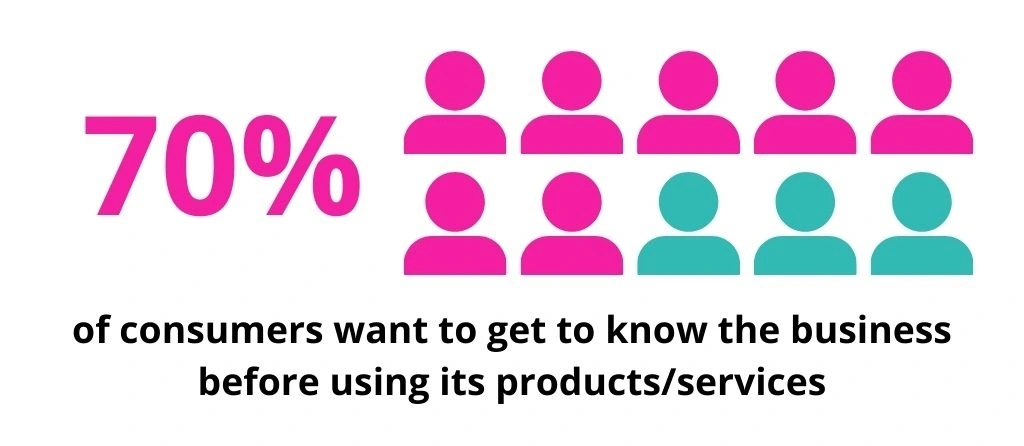
61. 70% of consumers say they prefer getting to know a brand through its content than ads.
62. Storytelling is one of the most effective strategies to engage the audience, used by 55% of successful content marketers.
4. FAQ
Now, let’s look into some of the most frequently asked questions about content marketing. We will try to answer them in an easy-to-understand manner so you can fully benefit from the provided information.
4.1 What Is Content Marketing?
Content marketing is a marketing approach focused on creating valuable, engaging, relevant, and trustworthy content. Its purpose is to attract potential clients and make them want to perform a particular action – share it with their peers on different social media platforms, purchase a specific product/service, subscribe to a newsletter, etc. Content marketing can help the company generate leads, establish trust in the brand, and educate and help existing customers.
4.2 Why Having a Content Marketing Strategy Important?
Content marketing is crucial since it provides the answers to your audience’s inquiries, helps build trust and long-lasting client relationships, improves conversions and lead generation, and aids with brand awareness and trustworthiness. The main perks of implementing a content marketing strategy include the following:
1) Proper delivery and presentation of your brand message
2) Potential rise in ROI.
3) Better communication with your audience.
4) Higher visibility on search engines and an increase in traffic
5) Reaching untapped markets and audiences.
4.3 What Is the Best Content Marketing Strategy?
There is no universal content marketing strategy effective for all business niches. It depends on a lot of factors like the type of offered services/products, geographic location, levels of competition, etc. However, every content marketing strategy must have the following 5 core elements:
1) Measurable brand goals
2) Clearly defined target audience
3) Buyer persona profile
4) Diverse, high-quality content
5) Different content marketing distribution channels
The content marketing industry is growing by the minute and has become more competitive than ever before. Marketers must carefully examine the available content marketing data to ensure that their marketing strategies will lead to the desired results. The stats will help them analyze the market, determine what their potential clients want to see, how to best present their brand, and more. Statistical data is a great source of knowledge if you know where to look. We hope we were able to shed light on content marketing and inspire you to better your own company strategy.